Plan Dalet- Battle around Safed
Plan Dalet—a defensive counteroffensive designed to reopen supply routes and prevent total collapse of Safed and Israel
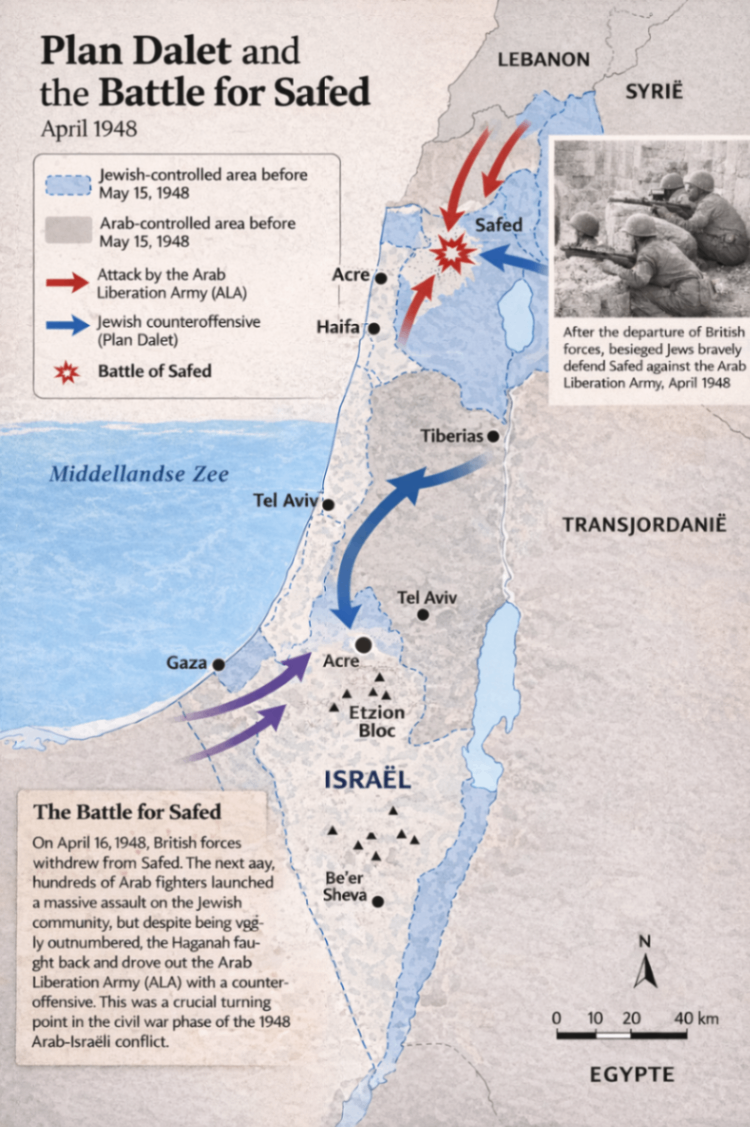
On April 16, 1948, British forces withdrew from Safed, and hundreds of Arab fighters immediately launched an assault on the city’s ancient Jewish community. The Arab commander sent a message to the Arab Liberation Army declaring, “Our morale is very high, the young people are enthusiastic, we’re going to massacre them.” Despite being vastly outnumbered, the Jewish residents refused to flee. Together with a small Haganah garrison, they fought back and successfully repelled the attack.
This assault was part of the civil war phase of the 1948 Arab-Israeli conflict, which began after the United Nations voted on November 29, 1947, to partition Mandatory Palestine into separate Jewish and Arab states. From the beginning, Arab leaders rejected any form of Jewish sovereignty. On the same day as the Safed attack, Jamal Husseini, acting chairman of the Arab Higher Committee, told the UN Security Council: “The representative of the Jewish Agency told us yesterday that they were not the attackers, that the Arabs had begun the fighting. We did not deny this. We told the whole world that we were going to fight.”
And fight they did. Following the UN vote, Arab forces unleashed widespread violence: buses were ambushed, passengers murdered, Jerusalem’s Jewish market was stormed by armed mobs, and convoys were destroyed with no survivors. Jewish civilians were dying at a rate of more than fifty per week. By March 1948, Arab forces controlled key roads, leaving Jewish communities isolated and Jerusalem’s Jewish population facing starvation.
In response, the Haganah launched Plan Dalet—a defensive counteroffensive designed to reopen supply routes and prevent total collapse. Contrary to later claims, it was not a plan for expulsion but a desperate measure for survival. Meanwhile, Arab leaders openly called for the extermination of Jews, shouting “Itbah al Yahoud!”—“Slaughter the Jews!”
On May 14, 1948, Israel declared independence. The next day, five Arab armies invaded with the explicit goal of destroying the new Jewish state. They failed. That defeat became known among Arabs as the “Nakba,” meaning “catastrophe.” Originally, the term referred to the humiliation of failing to destroy Israel, not to the refugee crisis that followed.
Most Arab residents fled before Israeli forces arrived, encouraged by their own leaders who promised a swift victory and return. Those who remained became full citizens of Israel, enjoying equal rights and now comprising over 20% of the country’s population.
Ultimately, there would have been no refugees had Arab leaders accepted the UN partition or refrained from launching a war of annihilation. The modern “Nakba” narrative reverses cause and effect, portraying aggressors as victims and erasing the reality that Jews fought for survival against an explicitly declared campaign of destruction.